
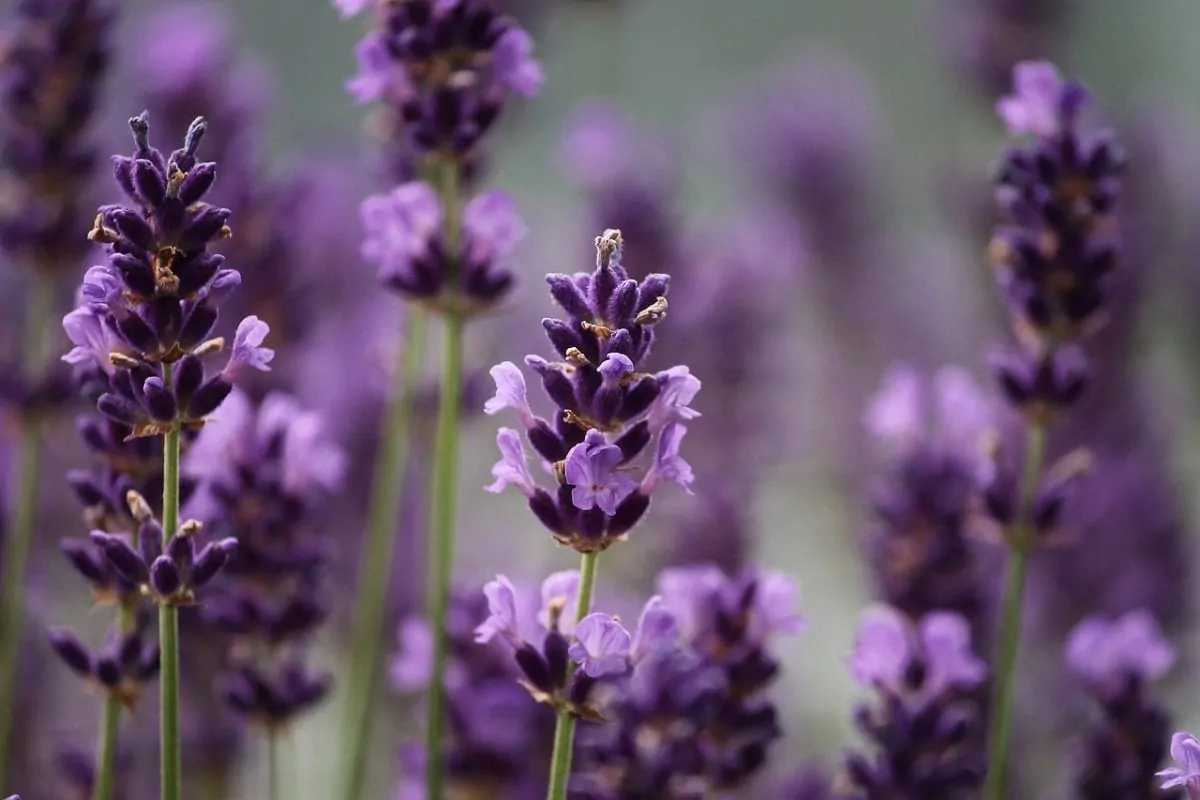
As soon as you think about the word lavender, one usually imagines English Gardens surrounded by the lovely blue-purple color of the plant. Or you may think of the exotic smell of potpourri and little sachets tucked away in your grandmother’s linen closet. Don’t you wish you could grow your own lavender? Don’t live in a conducive growing zone? Read this lavender plant care guide and we will give you everything you need to know on how to grow and care for lavender indoors!
Not all lavender will be happy indoors, unless you have a very large container, lots of room, or a greenhouse/sunroom. They can grow to be three foot high or more. You will need to find some dwarf varieties, such as Lavandula angustifolia ‘Munstead’. It only reaches 12-18 inches tall and is well suited for indoors.
Another dwarf variety is Lavandula angustifolia ‘Little Lottie’, (aka Clarmo). It has pinkish flowers and does well in pots. This plant has the distinction of being a Royal Horticultural Society Award of Garden Merit recipient.
There are others of course, and you can try some of the larger growing varieties, but you may be disappointed with your success. We suggest searching for and using the dwarfs.
Depending on your climate, lavender can be placed outdoors. It is listed as growing in Zones 5-9. In places that are very humid it does not do well, but fungus is its only real issue there. If you can avoid wetting the leaves and keeping it under an overhang to eliminate the dew falling on it, you will have a better chance.
Lavender is considered a long-lived plant, living up to fifteen years or more if properly cared for.
View this post on Instagram
You have decided what kind of lavender to grow, now, should it be from seeds or cuttings. Both options have advantages and disadvantages. If you know someone who already grows lavender, then growing from cuttings is a faster way to get plants to flower. If that option is not viable, then ordering plants or seeds online will be your next best bet.
There tons of reputable plant and seed companies online, just make sure that it is either listed for indoor use, or that it is indeed a dwarf variety. Seeds will germinate in two weeks using a seed starting medium and tray. The medium should stay warm, 70-80 degrees and moist, not wet. Once they have their first true leaves they can be planted in their permanent pot and placed in as much sunlight as you can give them.
View this post on Instagram
Lavender is originally from the Mediterranean region of the world and needs that kind of environment. Warm, dry, and cramped are three things to remember.
Using a terracotta container is a good way to start. The pot itself will wick moisture from the soil, which is a good thing in this case. It should only be about one to two inches larger than the plant root ball. That way there will be plenty of roots to use up the moisture.
If the soil that lavender is growing in stays moist for too long will, root rot is the inevitable result. Any soilless mix made for containers will suffice, just make sure that the pot has adequate drainage holes.
When it comes to indoors lavender plant care, light is going to be the biggest challenge. If you fail to give your plant enough light, it won’t give you ideal growth, leaf color, let alone bloom for you. The problem is indoor settings just don’t usually have enough light, especially in winter.
Ideally, lavender requires a minimum of six hours per day of full sun. So, depending on how your house it positioned, a southern exposure would more than likely give you enough light. Here again is another reason why the dwarf plants are better suited for indoor growing.
Most plants won’t fit in your window ledge. If you have a table or plant stand to place in front of the window, you can also use artificial lighting as a backup. There are many kinds of different grow lights on the market, find one that meets your lighting needs and fits in your budget.
Other than the obvious issues of inadequate light and not blooming well, the plant will tend to stretch and reach for any available light. Lavender will also just not be healthy as it will not be able to perform photosynthesis as well, leading to the poor leaf color mentioned previously.
Second only to sunlight in topics that are critical to growing lavender is watering. Fungus and root rot are common problems when growing lavender, especially indoors. Overwatering and allowing the soil to stay constantly moist will cause root rot.
On the flip side of that, you do not want the soil to get completely bone dry. If the lower leaves begin to turn yellow, it is getting too dry. You want to find that happy middle ground. If the soil is dry about an inch down, then water thoroughly.
Since you are growing the lavender indoors, water coming from the bottom of the pot can be an issue for furniture. You will want to use a saucer under the pot, just remember to empty it as soon as possible so that the plant doesn’t sit in water.
Feeding is not difficult, if you use an all-purpose water-soluble fertilizer, cut it to half strength, about every 4-6 weeks. If you use something like a slow-release fertilizer, once every 6-8 weeks should suffice.
View this post on Instagram
Outdoors lavender will begin to bloom in late spring, often going dormant in the heat of the summer, then reblooming in the early to mid-fall.
Indoors, depending on your conditions, age of the plant, and horticultural care, you could see it bloom for many months at a time.
View this post on Instagram
When you start cutting the stems for harvest, it causes new growth to emerge. Occasionally, if you want the plant to be fuller and bushier you can cut the tips of the new growth. Flowers are also produced at the tips so if you tip prune often, it will reduce flowering.
Most uses of lavender will call for the dried flowers. It is very simple to dry it and there are only a few simple steps.
As mentioned earlier, lavender can be used for potpourri and closet sachets. The scent is said to help promote wellness and relaxation. At one time people would tuck a few stems of lavender in their pillowcase to help them sleep better at night. The flower stems work wonderfully in dried flower arrangements to place by the front door to offer an inviting smell to your visitors.
If you enjoy taking a bath, take some crushed-up lavender and place it in a piece of cheese cloth or nylon stocking. Let it float around the tub with you, the warm water will release the essential oils and it will give you a soothing scent.
Fresh lavender can be used in salads, as cake topping decorations, or in a glass of sparkling water or champagne. It even adds a very nice touch to a dessert of citrus flavored sorbet.
As you can see, humans can eat lavender, but according to the ASPCA, it is mildly toxic to dogs and cats. There are conflicting reports, some say they would have to eat a large amount of it, others say it is fine. Either way, it is best to keep it away from them, just in case.
There are relatively few pests that will bother your lavender indoors. The occasional whitefly or aphid may show up. Both of those can be treated with insecticidal soap.
The great part is, we people love the smell of lavender while most insects like flies, gnats and mosquitoes despise it. Having the bunches drying close to the front door will help repel them and stop them from entering your home.
Other than root rot from too much water, lavender is also very unlikely to develop any serious disease issues.
If you choose the correct variety of lavender and follow our indoors lavender plant care, giving the plant all it needs, there is no reason why you should not be able to grow some of your own. Not only will you get the joy of growing the plant, but your friends and neighbors will also love coming by just for the aromatic experience.

Monthly updates on your favorite plants and how to keep them alive, delivered straight to your inbox!
Privacy Policy
This privacy policy outlines what info we gather from our visitors and contributors, the tools we use to collect, store, and protect it, and how we use this information.
Like any other website on the World Wide Web, YouHadMeAtGardening.com records some info about you and your device during your visit. This privacy policy outlines how our team gathers, stores, protects, and uses the information it gathers from visitors of the YouHadMeAtGardening.com website.
By continuing to use this website, you implicitly agree to this policy; if you do not agree to some or all of the procedures listed on this page, you can opt out at any time, however, you might not enjoy the intended browsing experience.
Our team reserves the right to alter this privacy policy with no prior notice to you. However, if the alterations made affect your personal data in any way, you will be notified immediately by email, on our homepage, or here.
Information YouHadMeAtGardening.com Collects
Our systems gather personally and non-personally identifiable information from visitors of the YouHadMeAtGardening.com website.
The only personally identifiable information we collect is your name and e-mail address only when leaving comments if you’re a visitor, or when submitting content and leaving comments, if you’re a contributor.
However, if you are not comfortable with providing your personally identifiable information to us, you can also use an alias instead of your real name and e-mail address without breaking any rules or regulations currently in use.
Note: If you submitted a comment using your personally-identifiable information and want it removed, you can always contact us and we will remove your info in 30 days.
The non-personally identifiable information we collect is your IP address, ISP information, device and browser info, and your browsing patterns – specifically the pages and websites you visit. This information cannot be used to track down your identity.
How We Collect Your Information
We use the following tools to gather personally and non-personally identifiable information from visitors and contributors:
• Cookies: these tiny text documents contain unique identifiers that are stored in your computer after your expressed consent. Cookies collect non-personally-identifiable information about your browsing patterns, which helps us pinpoint the areas of our website that require extra work and the areas that fully meet your needs.
• Log files: These tools record browser and device information, browsing patterns, websites that referred you to the YouHadMeAtGardening.com website, pages our website referred you to, and other types of non-personally identifiable information.
• Sign-up forms: these requests only come up when registering for our newsletter and is the only way our team collects personally-identifiable information from visitors.
How We Protect Your Information
All information we gather, both personally and non-personally identifiable, is stored in systems and databases managed only by the YouHadMeAtGardening.com team. We use the latest security measures to make sure the information you provide and the information we gather stays confidential, such as encryption, user behavior monitoring, and a series of managerial procedures.
How We Use Your Information
We only use your personally and non-personally identifiable information to improve the quality of the website and your browsing experience while here. We want to know which pages and sections of our website satisfy your needs and are of real value to you and which ones need improvement so we can make the proper adjustments. We also use your information to make sure the website is properly displayed on your device and browser.
If you choose to opt in for our newsletter, we will also use your information to keep in touch.
However, know that the YouHadMeAtGardening.com team will never share your information with other parties in exchange for financial rewards or any other kind of benefits. Some third parties might get very limited access to your info, but only to your non-personally identifiable information and only as we described above.
The personally identifiable information you provide is strictly confidential, therefore we will not share it with anyone.
Advertising
This Site is affiliated with CMI Marketing, Inc., d/b/a CafeMedia (“CafeMedia”) for the purposes of placing advertising on the Site, and CafeMedia will collect and use certain data for advertising purposes. To learn more about CafeMedia’s data usage, click here: www.cafemedia.com/publisher-advertising-privacy-policy